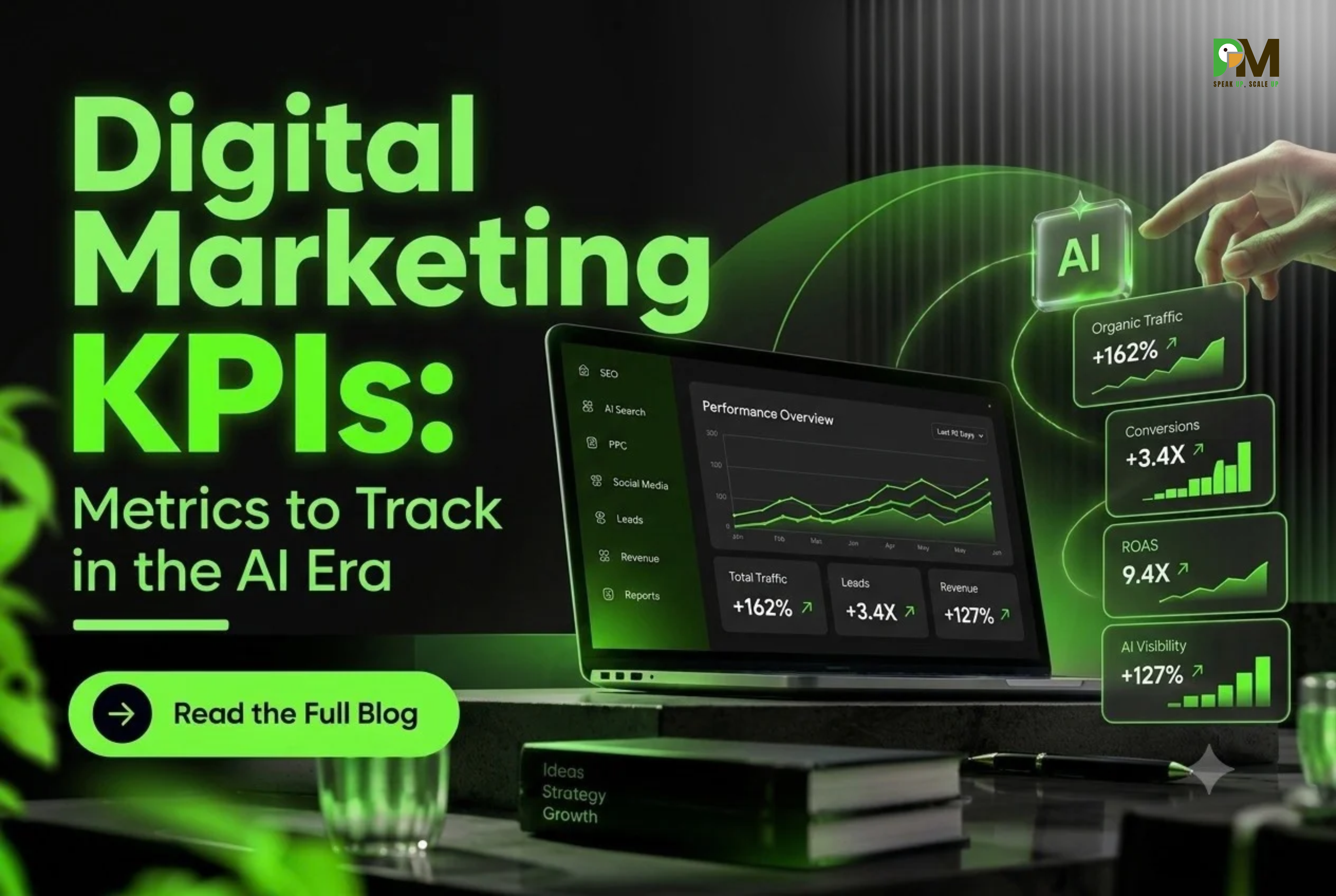
Digital Marketing KPIs and Metrics to Track in the AI Era
The right digital marketing KPIs and metrics help businesses understand what is actually driving visibility, engagement, leads, sales, and revenue.
Whether you work with an in-house team or a Digital Marketing Agency in Dehradun, tracking meaningful KPIs can help you make better decisions and allocate your marketing budget more effectively.
KPI vs Metric, Know the Difference First
A metric is any measurable value that helps you understand marketing activity. A KPI (Key Performance Indicator) is a metric directly connected to an important business objective.
For example:
-
Website visitors = Metric
-
Click-through rate (CTR) = Metric
-
Qualified leads = KPI
-
Customer acquisition cost (CAC) = KPI
-
Return on ad spend (ROAS) = KPI
In simple terms, every KPI is a metric, but not every metric is a KPI.
The most useful KPIs are connected to business outcomes rather than simply reporting large numbers.
Why Traditional Marketing Metrics Are Losing Reliability
Traditional metrics are still useful, but they should not be viewed in isolation. AI and changes in user behavior have made some surface-level numbers less reliable.
-
AI-generated search answers can reduce clicks to websites.
-
Users may interact with a brand across Google, social media, AI platforms, and multiple devices before converting.
-
Privacy changes can limit the availability of certain user-level data.
-
Automated ad platforms increasingly influence targeting and campaign optimization.
-
A high number of impressions does not necessarily mean strong business performance.
-
Website traffic can increase without producing qualified leads or revenue.
-
Last-click attribution may not represent the complete customer journey.
The focus is therefore shifting from “How many people clicked?” to “What business value did marketing create?”
Core Digital Marketing KPIs That Still Matter
Some KPIs remain highly valuable in the AI era because they connect marketing activity with measurable business outcomes.
Important KPIs include:
-
Conversion Rate: Percentage of visitors who complete a desired action.
-
Cost Per Lead (CPL): Average amount spent to generate a lead.
-
Customer Acquisition Cost (CAC): Cost required to acquire a customer.
-
Return on Ad Spend (ROAS): Revenue generated for every unit of advertising spend.
-
Return on Marketing Investment (ROMI): Financial return generated from marketing investment.
-
Organic Traffic: Visitors generated through unpaid search.
-
Qualified Leads: Leads that meet predefined sales or business criteria.
-
Customer Lifetime Value (CLV): Estimated revenue a customer can generate over the relationship.
These KPIs provide more context than traffic or impressions alone.
How to Build an AI-Era KPI Dashboard
An effective dashboard should make performance easy to understand. Instead of filling it with every available metric, organize it around business goals.
A practical dashboard can include:
-
Business outcomes: Revenue, sales, qualified leads and CLV.
-
Acquisition: Organic traffic, paid traffic, CPL and CAC.
-
Engagement: Engagement rate, time spent and returning users.
-
Conversion: Conversion rate, leads and purchases.
-
Advertising: ROAS, CPA and conversion value.
-
AI/search visibility: Brand mentions, citations and visibility across AI-generated results.
For example, a performance marketing dashboard should connect ad spend → leads → customers → revenue, rather than reporting ad clicks separately from business results.
How Often Should Marketing KPIs Be Reviewed?
The ideal review frequency depends on the KPI and marketing channel.
-
Daily: Ad spend, major campaign issues and conversion tracking.
-
Weekly: CTR, CPC, CPL, campaign performance and traffic trends.
-
Monthly: Leads, revenue, CAC, ROAS and channel performance.
-
Quarterly: Customer lifetime value, marketing ROI, strategy and long-term growth.
Avoid making major strategic decisions based on a single day's performance unless there is a significant tracking or campaign issue.
Engagement and Behavior Metrics Beyond Clicks
Clicks are only one part of the customer journey. Businesses should also understand what users do after they arrive.
Useful engagement metrics include:
-
Engaged sessions
-
Returning visitors
-
Scroll depth
-
Video engagement
-
Content interactions
-
Form-start and form-completion rates
-
Product views
-
Add-to-cart actions
-
Repeat purchases
-
Branded search growth
These signals can help identify whether users are genuinely interacting with your content or simply generating short-term traffic.
Tools to Track AI-Era Marketing KPIs
Different platforms provide different parts of the performance picture.
Popular tools include:
-
Google Analytics 4: Website behavior and conversions
-
Google Search Console: Search visibility, queries and organic performance
-
Google Ads: Paid search performance and conversion data
-
Meta Ads Manager: Social advertising performance
-
Google Tag Manager: Conversion and event tracking
-
Looker Studio: Reporting and dashboard creation
-
SEMrush / Ahrefs: SEO, competitor and keyword analysis
The key is not simply having many tools. It is connecting their data to meaningful business goals.
New AI-Era KPIs You Need to Start Tracking
AI is creating new ways for customers to discover brands. Businesses should therefore start monitoring AI-related visibility alongside traditional SEO metrics.
Some emerging KPIs include:
-
AI Search Visibility: How frequently a brand appears in AI-generated answers.
-
AI Brand Mentions: How often AI systems mention the business or brand.
-
AI Citations: Whether AI-generated responses reference the brand's website or content.
-
Share of Search: A brand's visibility compared with competitors across relevant searches.
-
Branded Search Growth: Changes in searches specifically related to the brand.
-
Content-Assisted Conversions: Conversions influenced by informational content before the final action.
These metrics are particularly relevant as search evolves from traditional blue-link results toward conversational and AI-powered experiences.
Conclusion
The AI era does not make traditional digital marketing KPIs irrelevant. Instead, it requires marketers to interpret them in a broader context.
Traffic, clicks, CTR and impressions can still provide valuable insights, but businesses should connect them with leads, customers, revenue, retention, and brand visibility.
A modern Digital Marketing Agency in Dehradun can use this approach to build performance dashboards that combine SEO, paid advertising, social media, analytics, and emerging AI-search signals.
For businesses looking for a Best Performance Marketing Agency, the key consideration should be a measurement framework that connects marketing activity with actual business outcomes, not simply a report filled with numbers.
Frequently Asked Questions
Q1: What are the most important digital marketing KPIs?
The most important KPIs depend on business objectives, but common examples include conversion rate, qualified leads, CAC, CPL, ROAS, revenue, CLV and marketing ROI.
Q2: Are clicks and impressions still important in the AI era?
Yes. Clicks and impressions can help measure visibility and engagement, but they should be analyzed alongside conversion, revenue and customer-quality metrics.
Q3: What is an AI-era marketing KPI?
An AI-era KPI measures performance in areas influenced by AI-powered search and customer journeys, such as AI visibility, brand mentions, AI citations and branded search growth.
Q4: How often should digital marketing KPIs be reviewed?
Operational metrics can be reviewed weekly, while business KPIs such as CAC, revenue, ROAS and marketing ROI are generally more useful when reviewed monthly or quarterly.
Q5: Why should businesses track more than website traffic?
Website traffic shows how many users visit a website, but it does not necessarily indicate business value. Lead quality, conversions, customers and revenue provide a stronger understanding of marketing effectiveness.